

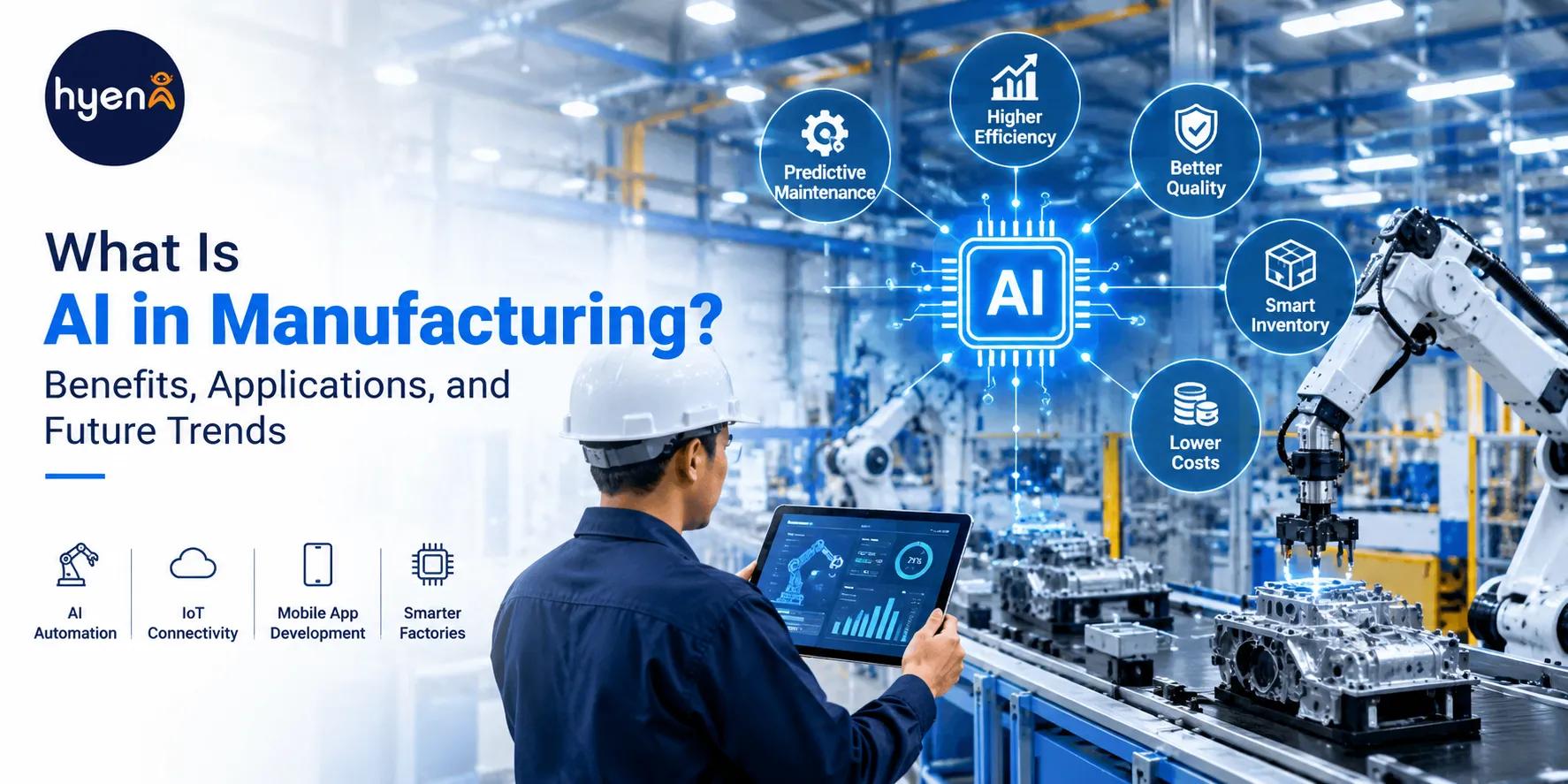
AI in Manufacturing
AI in manufacturing is the integration of artificial intelligence in manufacturing plants to make various operations intelligent and efficient. AI is a growing area in application development and more and more manufacturers are looking to leverage this in their businesses. Factories are becoming more interconnected and intelligent applications of AI are also being deployed.
How Does AI Work in Manufacturing?
AI is an all-pervasive technology and finds application in all verticals in a manufacturing plant. AI sifts through big data and identifies patterns, makes predictions and suggests solutions. Through this the manufacturing personnel can optimize their operations.
Predictive Maintenance
A good use case of AI in a manufacturing plant is to replace reactive maintenance with proactive or predictive maintenance. Using AI, it is possible to identify impending equipment failures.
5 Major Benefits of AI in Manufacturing
1. Equipment Failure Prediction
Through AI, it is possible to identify equipment failures even before it occurs and schedule equipment maintenance.
2. Product Inspection
Using Computer Vision, it is possible to inspect products for various anomalies and quality assurance.
3. Improving Resource Utilization
AI can analyze and interpret a variety of data and provide recommendations to improve operations.
4. Optimal Inventory
Using AI and ML, it is possible to better anticipate and plan for inventory.
5. Resource Planning
Through various data analyses, AI can help recommend the best production schedules.
Lower Operational Costs
Artificial intelligence (AI) offers a range of opportunities to enhance manufacturing operations. A reduction in costs due to enhanced identification of waste and downtime reduction is well documented. Energy efficiency and optimisation processes are further benefits offered by AI.
These advantages are detailed in several research papers, of which a 2026 paper provides a general overview of the role of artificial intelligence in various industries including manufacturing.
The Scope of AI in Manufacturing
A number of manufacturing plants have fully integrated various AI applications across numerous facilities and equipment.
Predictive maintenance involves using artificial intelligence to assess the health of equipment in order to identify potential faults.
AI may also be integrated to perform quality inspections to identify defects in manufactured products.
Additionally, AI applications may be utilized to plan and manage manufacturing activities, as well as facilitate the optimisation of supply chain and logistics activities.
Manufacturing activities may be digitally reproduced using AI.
A number of other applications of artificial intelligence are integrated throughout manufacturing facilities and equipment to gather and analyse data to be used to improve manufacturing activities.
The importance of data will increase with the integration of more advanced AI systems, and human oversight will be required to ensure generative AI systems do not produce unlawful outcomes.
Recent trends in AI manufacturing systems and applications aim to improve the connectivity of various systems and equipment. Integrating AI into manufacturing systems will allow manufacturing equipment to be more responsive, flexible and agile in meeting the varying and often unpredictable demands of customers.
Helps employees access information and supports good decisions while still requiring the exercise of professional judgment.
How Hyena Information Technologies Supports Manufacturing Innovation
The cost to develop an AI manufacturing app varies based on the features and the complexity of the integrations and the platforms.
The cost to develop a custom manufacturing app similar to Cost to Develop an App like Manufacturing 360 would also depend on the features and integrations.
The cost to develop an app for the manufacturing industry would also depend on the features and integrations, as well as the workflows supported by the app.
Hyena Information Technologies also offers mobile app development for the manufacturing industry.
The company offers services to assist organizations in implementing digital production and management systems.
Hyena offers AI development and consulting services and has experience in several areas including manufacturing management systems and manufacturing automation.
The company can assist in developing apps for manufacturing as well as other systems.
Contact Hyena Information Technologies to learn more.
Conclusion
AI allows manufacturers to enhance equipment and product tracking, improve product and process quality, and optimize and automate production planning and scheduling. The rate of AI innovation will likely outpace a manufacturer’s ability to assimilate and integrate the technology into their environment. The greatest opportunity for advantage will likely come from the manufacturer’s ability to define and architect a solution to a strategic business challenge.
Hyena Information Technologies has the expertise to help develop tailored AI and IoT solutions to transform your business.
If your business is ready to transform your manufacturing processes, contact Hyena Information Technologies.
1. What is the main function of AI in manufacturing?
AI innovations give manufacturers the opportunity to improve equipment and operational flexibility and improve product quality.
2. Is it possible to couple AI with existing manufacturing equipment?
In most cases, the answer is yes. AI can be integrated through a variety of connectors including sensors, gateways, and other devices.
3. What are the basic concepts of smart manufacturing?
These concepts include but are not limited to computer vision, IoT, robotics, digital manufacturing, and edge computing.
4. Can AI develop applications to support manufacturing on mobile devices?
Yes, through the development of tailored mobile applications, manufacturing personnel can be granted real time access to and control over manufacturing and operational processes.