

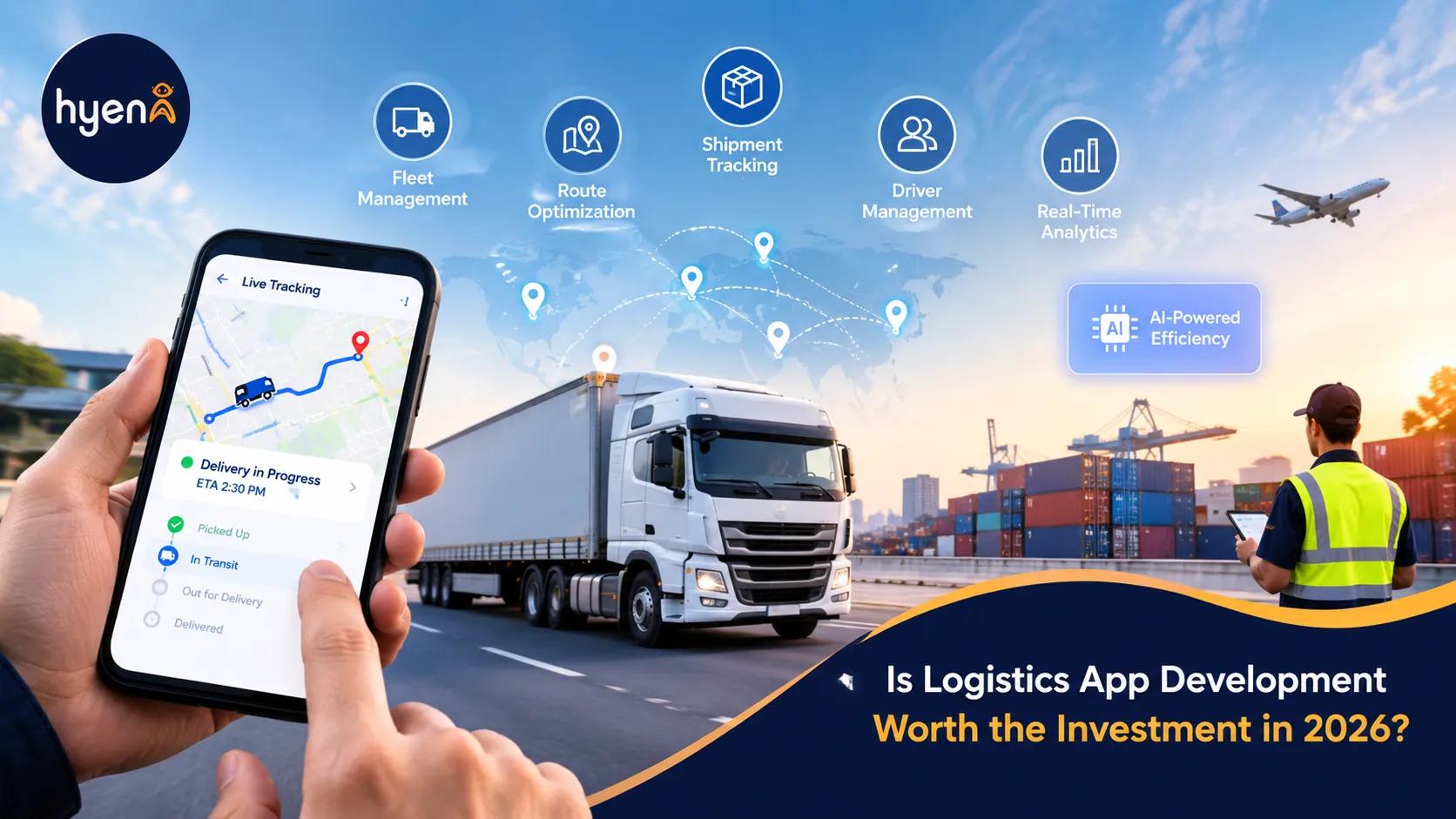
Logistics app development will be a worthwhile use of a business’s resources within the next couple of years, especially for those that are expecting to have growing delivery demands with many vehicles and drivers, complex delivery routes, and the need for real-time updates from customers. A well designed logistics app development system can connect disparate operational components, bringing about reductions in delays, improvement in overall visibility, and increased efficiency in overall decision-making.
The timing is rather opportune for companies to invest in a logistics software in India USA. Logistics companies are expecting rapid growth in demand for both domestic and international trade as a result of increasing eCommerce, direct to consumer (D2C) and quick commerce. There are also positive signs that AI will play a role in providing efficient logistics and transport solutions, and will rapidly come to inform how businesses will plan their routes, and make operational decisions.
What Is A Logistics App?
A logistics app is a type of software application used to manage the operations related to the movement of goods, drivers, and vehicles.
Imagine for example a delivery business managing 200 vehicles. Without a unified system a dispatcher may have to make a large number of phone calls, reference numerous spreadsheets, answer customer calls, and manually update delivery status, which is a very time-consuming and unwieldy process.
A logistics application can consolidate all these disparate activities. This is achieved using features such as:
GPS tracking of shipments and vehicles
Driver management
Proof of delivery
Automated dispatch
Order and shipment management
Customer delivery status notification
Real time shipment tracking
Portal for customer shipment visibility
Fuel management
Business performance analytics
An advanced logistics application will integrate artificial intelligence, which has become a differentiating feature for companies such as DHL, one of the leading logistics companies in the world, which has identified generative AI as one of the important trends that will affect logistics.
This means a logistics application in 2026 isn’t just a tracking tool. It can be a decision-making support tool.
Steps of Logistics App Development
Building a successful logistics platform requires more than simply adding GPS and a delivery screen. The development process usually starts with understanding the actual business workflow.
1. Define Business Requirements
First, identify what the app needs to solve. Is the biggest problem delayed deliveries, poor fleet visibility, inefficient routing, or customer communication?
This step determines the features, technology, integrations, and expected logistics app development cost.
2. Design the User Experience
Drivers, dispatchers, administrators, and customers don't use the same interface. A driver may need a simple navigation and delivery-status screen, while an administrator needs detailed fleet analytics.
Keeping each experience focused makes the application easier to use in real-world situations.
3. Develop Core Features
The development team can then build essential modules such as GPS tracking, dispatch management, order handling, driver management, notifications, and reporting.
For businesses managing large vehicle networks, Fleet Management Applications can also include maintenance schedules, fuel monitoring, vehicle utilization, and driver performance insights.
4. Add AI and Automation
This is where a modern logistics platform can become much more valuable.
AI can support demand forecasting, route optimization, predictive maintenance, customer-service automation, and anomaly detection. DHL's recent logistics research highlights advanced analytics and AI as increasingly important for improving operational decision-making.
5. Test, Launch, and Improve
Real-world testing matters. A route that looks perfect on a dashboard may not work well during traffic, weather disruptions, or unexpected delivery changes.
Launching with a practical MVP, collecting feedback, and continuously improving the platform is often more sensible than trying to build everything at once.
How Logistics Can Benefit Businesses
The biggest advantage is visibility. Managers can see where vehicles are, what orders are pending, and where bottlenecks are developing.
A good app can also help businesses:
Reduce unnecessary mileage and fuel consumption
Improve delivery planning
Increase driver productivity
Provide customers with accurate delivery updates
Reduce manual paperwork
Identify operational inefficiencies
Monitor fleet performance
Make data-backed business decisions
There is also a bigger shift happening. Logistics is increasingly becoming an intelligent, data-driven part of the business rather than simply a backend delivery function. AI is helping companies move toward predictive and proactive operations instead of reacting after something goes wrong.
Why Choose Hyena Information Technologies?
Choosing the right logistic app development company is important because the application has to work with real operational challenges, not just look good in a demo.
Hyena Information Technologies focuses on building customized digital solutions around business requirements, including AI App Development, Android app development, fleet solutions, and logistics platforms.
Rather than treating every logistics business the same, the development approach can be tailored around fleet size, delivery workflows, customer requirements, integrations, and future scalability.
For businesses asking how to develop a logistics app, the better question is often: What should the app automate first, and where can technology create measurable operational value?
Conclusion
So, is Logistics App Development worth the investment in 2026? For businesses handling regular transportation, deliveries, fleets, or complex supply-chain operations, the answer is generally yes provided the app is built around genuine operational needs.
The goal isn't simply to create another mobile application. It's to build a connected system that helps people plan better, respond faster, and deliver more reliably.
With AI, real-time tracking, automation, analytics, and scalable mobile technology becoming increasingly important, investing in the right logistics platform today can give businesses a stronger foundation for tomorrow.
Book an executive AI briefing to explore AI use cases for your business.