

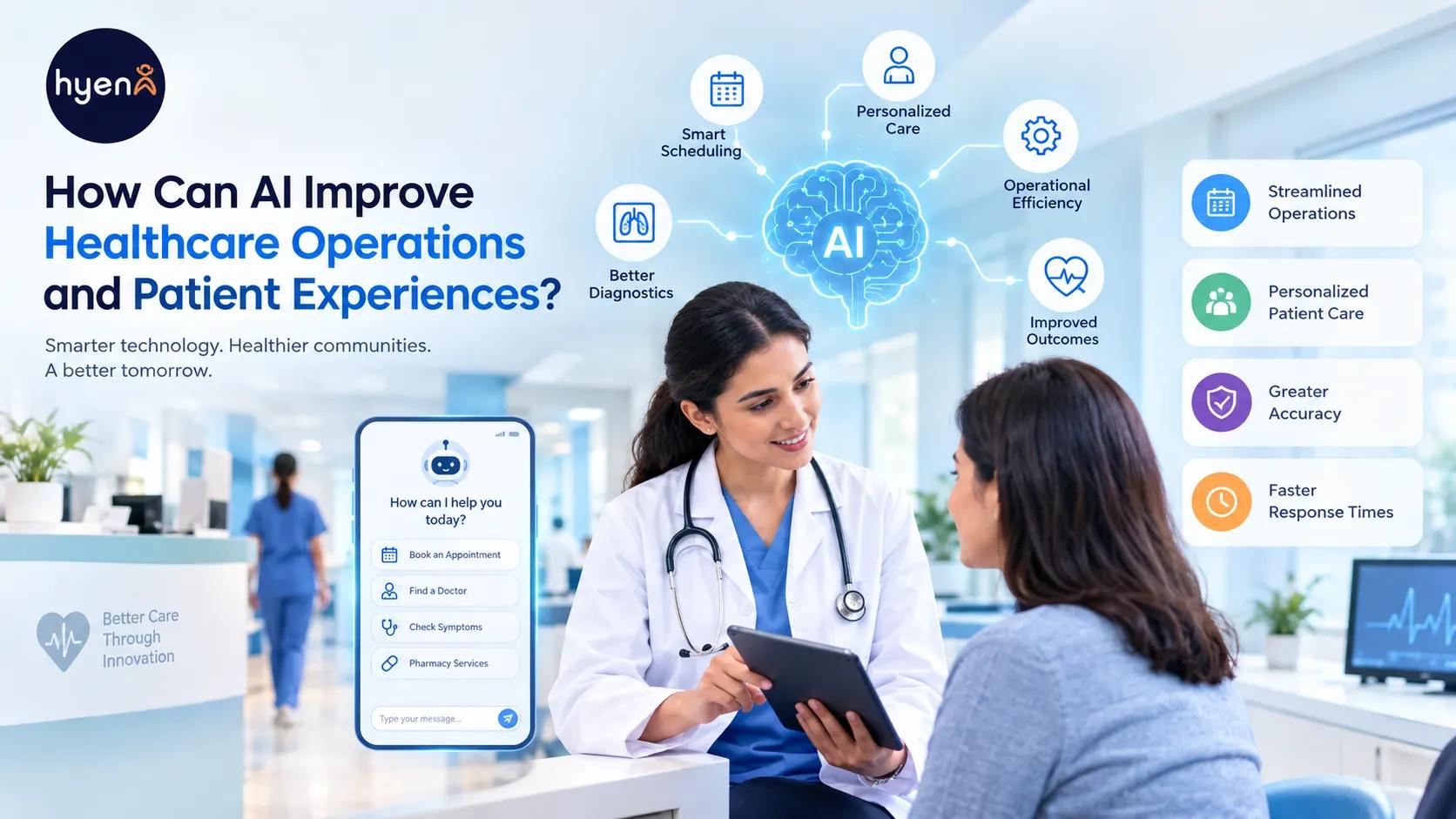
AI Improve Healthcare Operations
There are several opportunities for AI to revolutionize workflows and enhance the patient experience within the healthcare industry. Automating tasks, aiding clinicians to make timely decisions, and creating flexible services are just a few ways that AI can improve clinical services. AI can also help healthcare organizations create mobile and digital solutions that enable patients to access and manage their care in more convenient and personalized ways.
When Will We See Widespread Adoption of AI in Healthcare?
2025 was an important year for the widespread adoption of AI in Healthcare industry. This is because, until recently, the main obstacle to more broad adoption of AI in the healthcare sector was the lack of actual use cases. In addition to clinical documentation and triage, the use of AI in healthcare has gained traction for functions such as data science, operations, virtual care, and other services. Given the significant backlogs in the healthcare system and the limited time staff has to review information, AI can help alleviate some of the staff’s data review and analysis burdens.
Trends in artificial intelligence in healthcare have paralleled trends in other industries and sectors. Computational power and advances in machine learning have intersected with other emerging technologies such that deploying AI in healthcare has become economically and technologically viable. While the hype surrounding AI in healthcare has diminished, the reality is that, like other industries and sectors, AI has the potential to transform and improve healthcare.
Healthcare is still largely institution based. Think of an outpatient clinic. Patients’ interactions with the clinic are increasingly mediated by AI. Reminder and confirmation texts and reminders for appointments have all but replaced traditional, paper-based, synchronous, reminder and confirmation systems. Intake questions have been automated. Using AI to triage patients is becoming commonplace. Staff can and should be assisted by AI to offload tasks and focus on more difficult and nuanced, individualized judgment and care.
AI cannot and should not be developed and integrated into healthcare systems for the sake of integrating AI. Developing a mobile app to assist in integrating and interpreting clinical data, or assisting and supporting staff in patient care, are worthwhile endeavors and should be pursued by a mobile app development company.
The Evolution of AI in Healthcare: What Has Changed?
Earlier healthcare AI projects often focused on narrow predictive models. Today, multimodal AI can work across different forms of information, including text, images, and other data types. WHO published dedicated guidance on large multimodal models in healthcare in 2025, while emphasizing the need for responsible implementation.
Still, several barriers remain:
Patient privacy and data security
AI bias and inaccurate outputs
Integration with existing hospital systems
Regulatory requirements
Staff training and adoption
Human oversight of clinical decisions
WHO continues to stress transparency, accountability, safety, equity, and human oversight when AI is used in healthcare.
Benefits of AI in Healthcare
AI can support healthcare organizations in several practical ways:
Faster administrative workflows: Automate scheduling, reminders, documentation support, and routine communication.
Personalized patient experiences: Provide relevant information based on a patient's needs and interactions.
Operational efficiency: Identify appointment bottlenecks, staffing patterns, and resource-demand trends.
Clinical decision support: Help clinicians organize and interpret large amounts of information.
24/7 digital assistance: AI assistants can answer routine questions and guide patients toward appropriate services.
For businesses considering the Cost to Develop a Healthcare App, these AI capabilities can affect the overall budget because advanced analytics, AI models, integrations, security, and compliance require additional development and testing.
AI Assistants for Clinical Specialties
AI assistants can support specialty-specific workflows without replacing healthcare professionals.
AI in Emergency Medicine: Faster Triage and Critical Care Decisions
In emergency settings, minutes matter. AI can help organize incoming patient information, identify potentially urgent cases, summarize relevant records, and support prioritization.
The important distinction is that AI should assist the clinical team—not independently make high-risk medical decisions.
AI in Medical Imaging: Accelerating Precision Healthcare
Medical imaging is another area where AI can assist specialists by analyzing scans and highlighting patterns that may require closer attention. Proper validation, clinical oversight, and integration into existing workflows remain essential.
AI in Clinical Workflows, Operations, and Key Use Cases
AI can support more than diagnosis. Healthcare organizations can use it for:
Appointment scheduling and optimization
Patient reminders and follow-ups
Medical documentation assistance
Revenue-cycle and administrative workflows
Pharmacy and inventory forecasting
Patient engagement
Healthcare analytics
For example, businesses researching the Cost to Develop an App like Apollo Pharmacy or the Cost to develop a Doctor and patient appointment app like Okadoc should consider AI features as part of the product architecture rather than treating them as an afterthought.
Patient Triage and Virtual Care Coordination
An AI-enabled healthcare app can collect basic symptoms, understand the patient's reason for contacting the provider, and guide them toward the right service. Virtual assistants can also help with appointment changes, reminders, FAQs, and post-consultation communication.
The goal is simple: reduce unnecessary friction for patients while giving healthcare teams more time for meaningful care.
How to Implement AI in Hospitals
Successful implementation usually starts with one measurable problem rather than trying to “AI-enable” the entire hospital.
Identify a workflow with clear operational value.
Define the data required and verify its quality.
Select an appropriate AI model or architecture.
Integrate securely with existing healthcare systems.
Establish human review and escalation processes.
Test accuracy, security, usability, and performance.
Monitor results continuously after deployment.
At Hyena Information Technologies, the focus can be on building healthcare applications where AI supports real business and patient needs from intelligent appointment platforms and virtual assistants to analytics-driven healthcare solutions and Android App Development.
AI is not a replacement for healthcare professionals. Used thoughtfully, it can remove some of the repetitive work around them and help patients navigate care with less frustration. That practical balance technology working alongside people is where healthcare AI becomes genuinely useful.
Book an executive AI briefing to explore AI use cases for your business.